
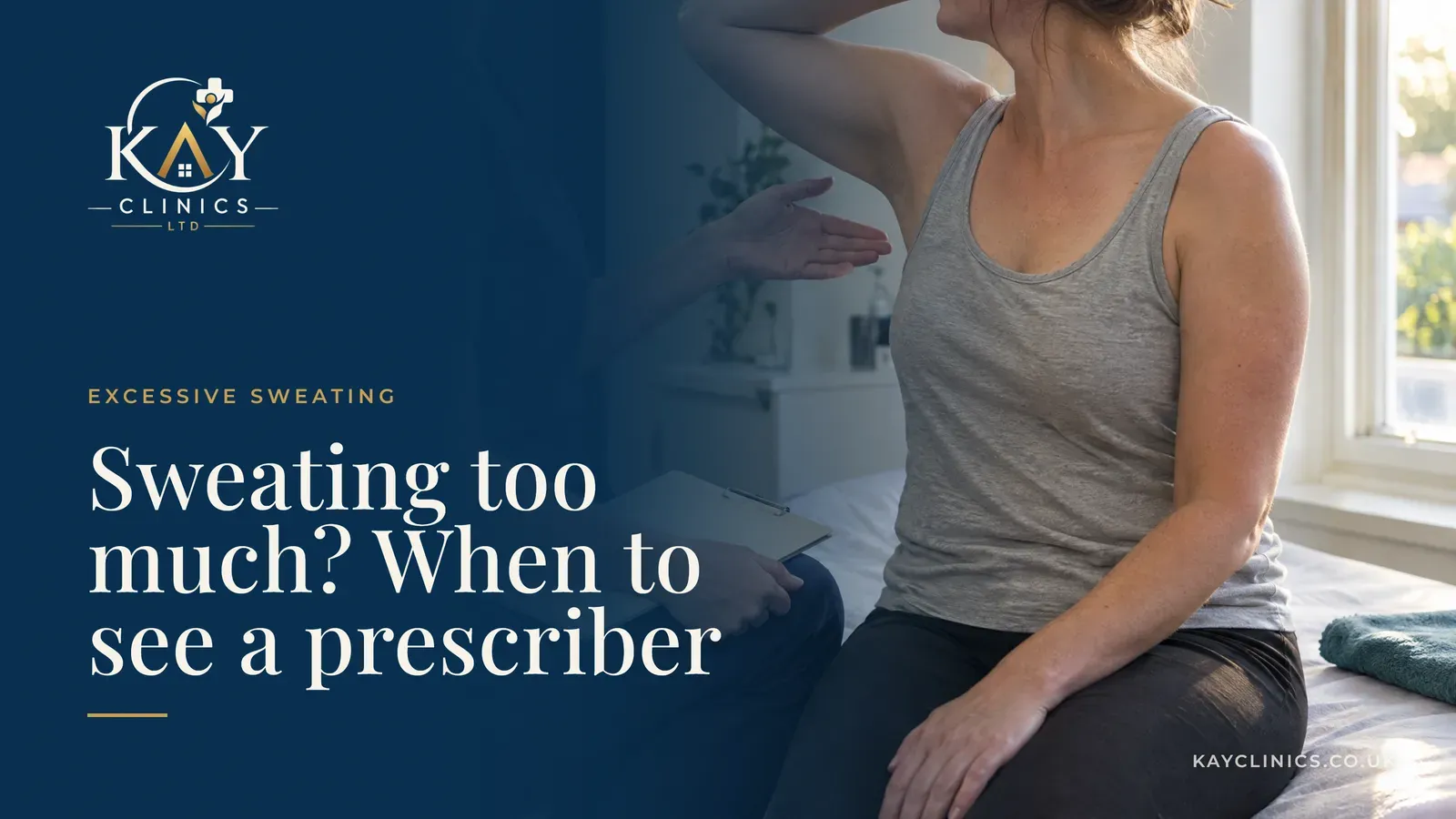
Sitting in a cool office, not moving a muscle, and your shirt's already sticking to you? It's natural to wonder if that's normal, or if you're sweating too much. The NHS counts it as excessive when you're sweating and your body doesn't need to cool down, and it's a common problem. Once the stronger antiperspirants from the chemist have stopped helping, it's time to talk to someone about it, and the NHS points you to your GP. If you'd like to look at treatment privately, a prescriber can help with that too.
That second part is what we do at KAY Clinics in Wickersley. Before you get to us, though, there are a few simple things worth trying, and a few signs that mean your GP should hear about it first.
How much sweat is too much?
Everybody sweats, and sweating when you're hot or you've been exercising is just your body doing its job. Excessive sweating, which doctors call hyperhidrosis, is the sweat that turns up when there's no heat to cope with, and it can affect your whole body or just certain areas.
A handy test is to think back over the last week or so to the times it really bothered you, and ask whether you were hot or had been rushing about. If the answer's usually no, that's sweat your body didn't need to make, and it's a perfectly fair thing to ask a pharmacist, your GP or us about, even if saying it out loud makes you cringe a bit.
It can happen for no obvious reason, or it can come from another condition or be a side effect of a medicine you're taking. Those three causes are worth keeping in mind, because they decide who you should talk to first.
The easy things to try at home first
Before anyone prescribes anything, give the simple changes a fair go. Loose clothes hide the signs better, and tight fits and synthetic fabrics like nylon tend to make things worse. If it's your feet that bother you, go for socks that soak up moisture and change them at least twice a day if you can. Leather shoes are a better bet, and it helps to swap pairs from one day to the next rather than wearing the same ones. Enclosed boots and trainers are best avoided. Alcohol and spicy food can make sweating worse too, so keep an eye on whether your bad days line up with either.
Your local pharmacy is a good next stop. You can buy a stronger antiperspirant there in place of an everyday deodorant, sweat shields that sit inside your clothes, foot powders, and soap substitutes that are gentler on your skin. None of it needs a prescription, and a pharmacist can talk you through which might suit you. If one of those does the job, that's brilliant, and you may never need the rest of this.
When to see your GP first
Some sweating is a sign that something else is going on, and that's a question for your GP, not an aesthetics clinic. The NHS advice is to see a GP if the home remedies aren't helping, if it's gone on for six months or more, or if it's getting in the way of your day. Book in as well if it happens at least once a week, if it runs in your family, if you take medicine for another condition, or if you're waking up in the night soaked through.
If either of those last two sounds like you, don't skip this step. Your GP can look at the bigger picture, and if they think another condition could be causing it, they may send you for tests.
When sweating too much is a job for a prescriber
Then there's the group with no obvious cause, where the simple things haven't helped. For them, the NHS says a specialist may recommend tablets that reduce sweating, a cream, a treatment called iontophoresis that passes a weak electric current through water, a prescription-only treatment for underarm sweating, or in some cases surgery. That underarm option may not be available on the NHS, so if it's the one you're thinking about, a private clinic is one way to ask about it.
This is the part we can help with. Because it's a prescription-only medicine, someone qualified to prescribe has to assess you and decide whether it's right for you, and at KAY Clinics that's Shuaib Hanafi, a UK pharmacist and Independent Prescriber. There's more on why being treated by a pharmacist prescriber makes a difference in another of our pieces.
What happens when you come and see us
Everything starts with a free consultation. You talk about what's bothering you, what you're hoping for and your medical history, and Shuaib gives you a straight answer on whether treatment suits you at all. If it doesn't, that's a useful thing to know too, even if it isn't the answer you walked in hoping for. If you'd like the step-by-step version first, we've written up how the free consultation goes.
If treatment does suit you, you'll go home with the plan in writing, price included, the same day, and you're free to sleep on it or decide it's not for you. When you do have treatment, you'll sign a consent form and we'll take a few photos, then the treatment itself happens in a calm clinical room, and you leave with your aftercare written down. We see you again around two weeks later to check how you're getting on, and that review, like your follow-ups, is complimentary. Every price is on our excessive sweating treatment page, so the cost is never a mystery before you get in touch. Nobody can honestly promise a result with this, and individual results vary, so we won't pretend otherwise.
Where to start this week
If you haven't tried the pharmacy yet, start there, because a stronger antiperspirant is an easy thing to try and might be all you need. If you're getting night sweats or you're on medicine for something else, book in with your GP. And if you've done both and you're still choosing your clothes around it, come and have that free chat with Shuaib. There's a booking page if you'd rather do it online, and if you'd sooner talk first, 07746 334403 takes calls and WhatsApp messages.